Share this Article


Ask five homeschool parents what Bible curriculum they use, and you’ll get five different answers, half of them defended like a hill worth dying on. That’s usually a sign there’s no single right answer here — just a right answer for the kid sitting at your table this year.
What Is a Homeschool Bible Curriculum and Why Does It Matter?
A homeschool Bible curriculum is a planned path through Scripture and doctrine, built so a parent isn’t improvising lesson content every Monday. Without one, Bible time tends to slide first when the week gets busy — not because parents don’t care, but because math has a workbook waiting and Bible often doesn’t.
The best homeschool Bible curriculum for your family isn’t the most popular one online. It’s the one that survives an actual Tuesday, when everyone’s tired, and nobody wants a forty-minute lesson.
What to Look for in a Bible Curriculum for Homeschooling
Look past the packaging and check three things: how much reading it demands of a young student, whether it teaches denominational specifics or stays broadly biblical, and how much prep it asks of you the night before. A non-denominational homeschool bible curriculum travels better across co-ops and extended family, since it sticks closer to shared Scripture than to a tradition’s finer points.
For an elementary homeschool bible curriculum, favor short daily lessons over one long weekly session. A six-year-old retains more from fifteen minutes a day than a single Friday marathon — this tracks with what the American Academy of Pediatrics notes about attention spans at this age, which stay short and respond better to brief, repeated exposure than long sittings.
The Best Homeschool Bible Curriculum Resources
Price turns out to be a poor way to sort these. Some of the best material costs nothing, some of the paid programs are worth every dollar, and the more useful question is what job you need filled — a spine for the week, something a kid can do alone, or help for the parent doing the teaching.
Ministry-to-Children.com is a great place to start if you want lessons on paper. Years of printable lesson plans, coloring pages, and memory verse cards, all free, sorted by age from toddlers up through preteens. It’s written by people who actually run children’s ministries rather than a publisher’s team, so the tone shifts from lesson to lesson—which honestly makes it read less like a program and more like advice from someone who’s taught this. Print a month at a time and keep it in a folder by the table. Bible survives a busy week when it has paper waiting for it, the same way math does.
The Gospel Project for Kids moves through the whole Bible story over several years and is unusually strong on discussion material, which matters if you’re sharing the load with a co-op.
Positive Action for Christ is the more traditional option, built around workbooks, and suits families who want daily assignments a kid can mostly get through on their own by third or fourth grade. Both are paid, and both are commitments you make for a year, so pull sample lessons before ordering.
The Bible App for Kids, from YouVersion and OneHope, is free with no ads at all — animated stories with things kids can tap and small challenges to work toward. Most children figure out the navigation themselves around three or four, which is the whole appeal, because you don’t have to supervise it.
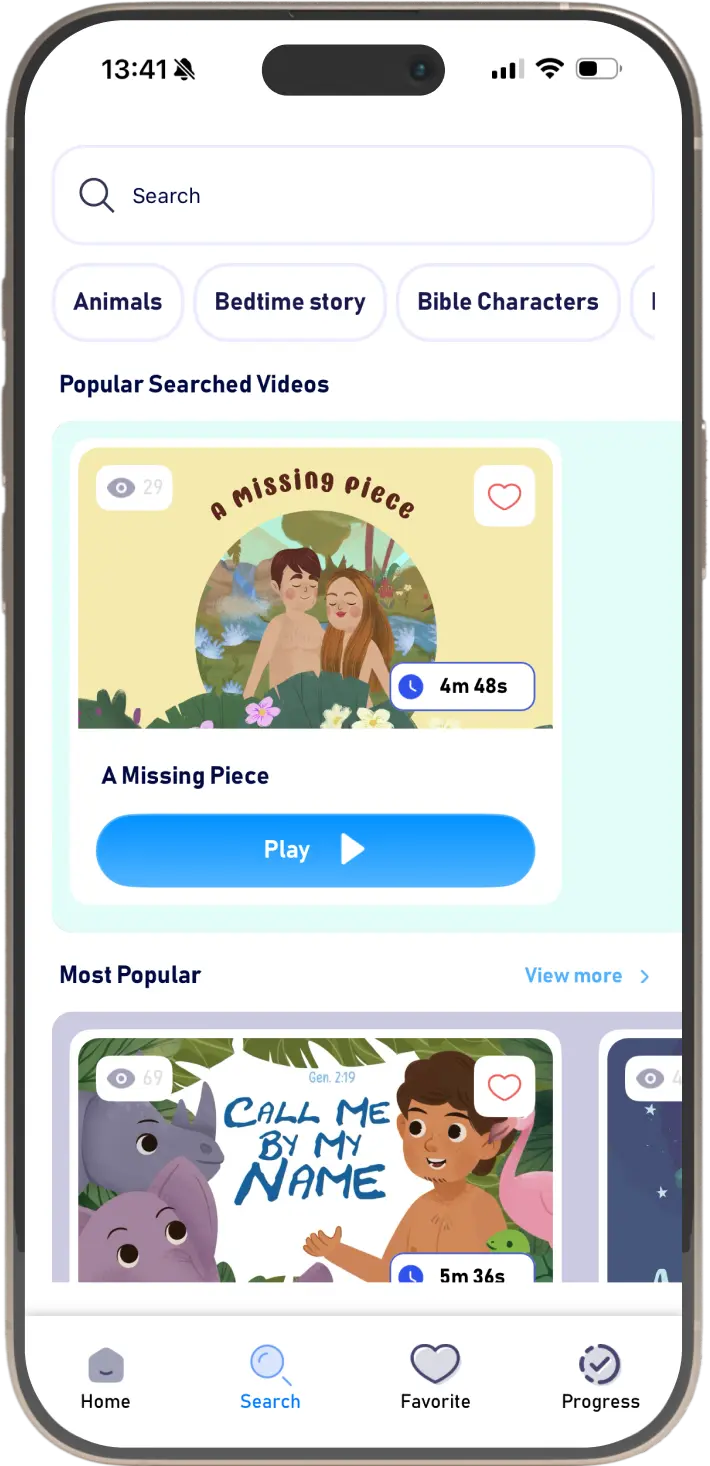
AbbaKid covers similar ground with a different feel: animated stories grouped into Animals, Bible Characters, Life of Jesus, and Bedtime Stories, each followed by a short quiz, no ads, trophies for right answers. It’s free to try, and the paid tier lets you download episodes offline, which pays for itself the first time you’re two hours into a car trip with no signal.
Worth adding one thing aimed at you rather than the kids. Holy Reads takes over a thousand Christian books, from theology to parenting, and boils each down to about twenty minutes you can read, listen to, or watch. It’s $2.49 a month, less than a single teacher’s manual, and the content is checked by scholars with PhDs. It fixes something no curriculum does: you’re teaching Genesis this quarter, and you haven’t read a serious word about Genesis since college. Listen on the school run. Teach better on Tuesday.
How to Choose the Right Bible Curriculum for Your Child’s Age and Learning Style
A curriculum that thrilled your oldest can fall flat with a second kid who learns differently. Watch what actually works: does she remember the verse the next day, or recite it word-perfect at 4 p.m. and forget it by breakfast? That gap matters more than any publisher’s grade-level label.
None of this fully solves the guilt that creeps in when Bible time gets skipped for three days in a row. It happens in every homeschool house, curriculum or not. AbbaKid’s story library works well as a light supplement on those weeks — short, narrative-driven Bible stories a kid can watch or read independently when a parent’s hands are full with something else. Worth adding to the rotation if your family is patching together resources this year.